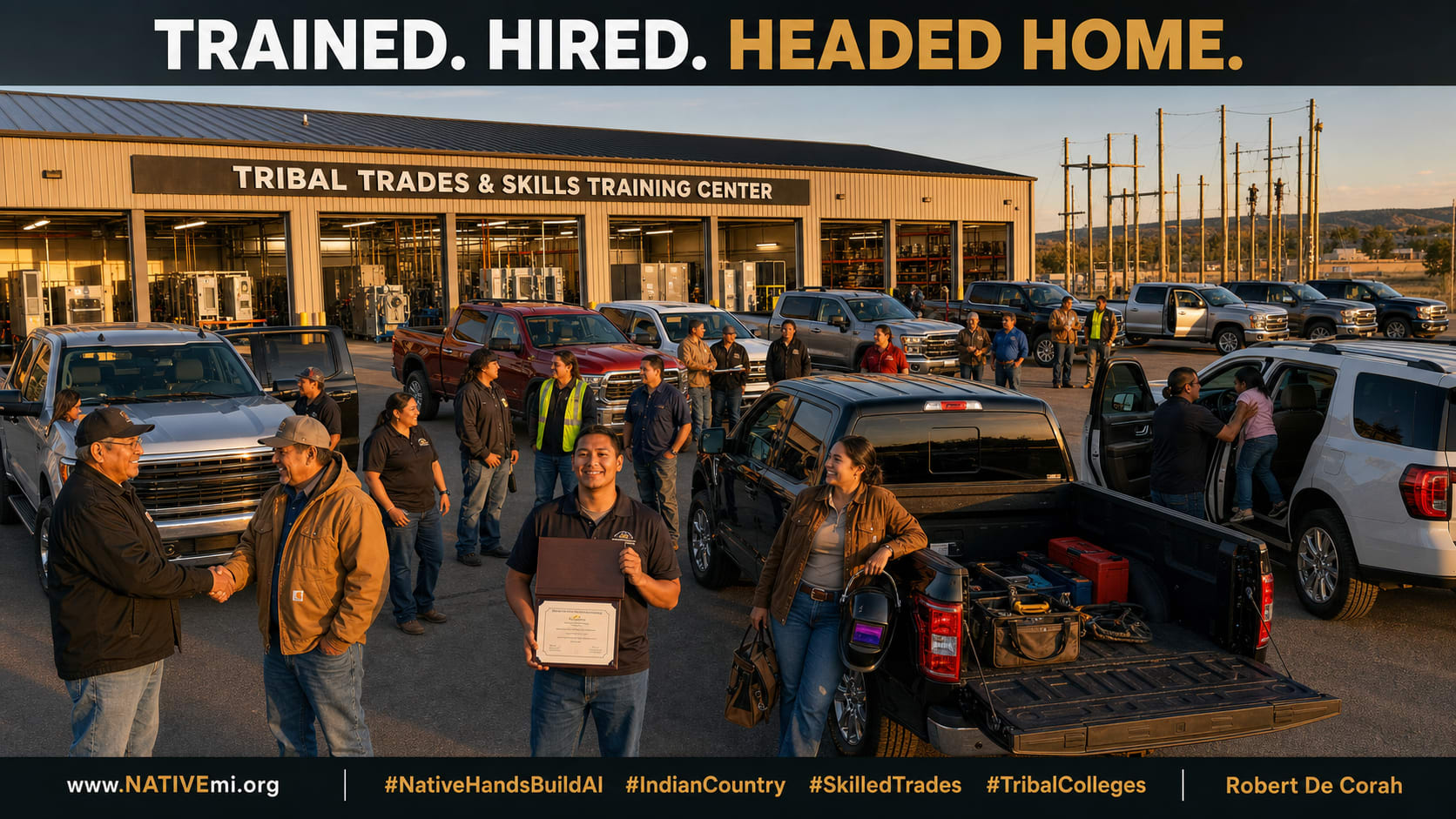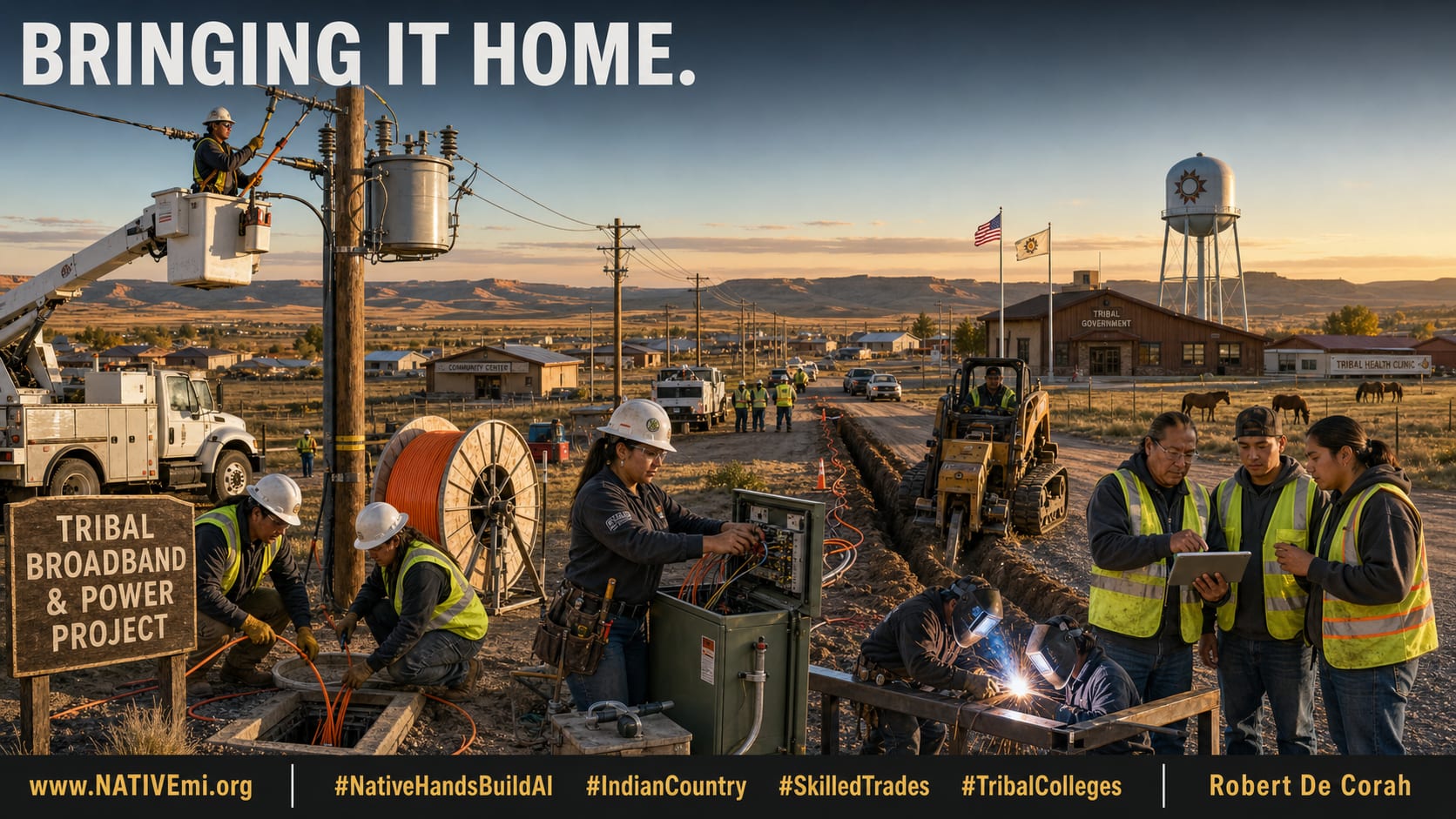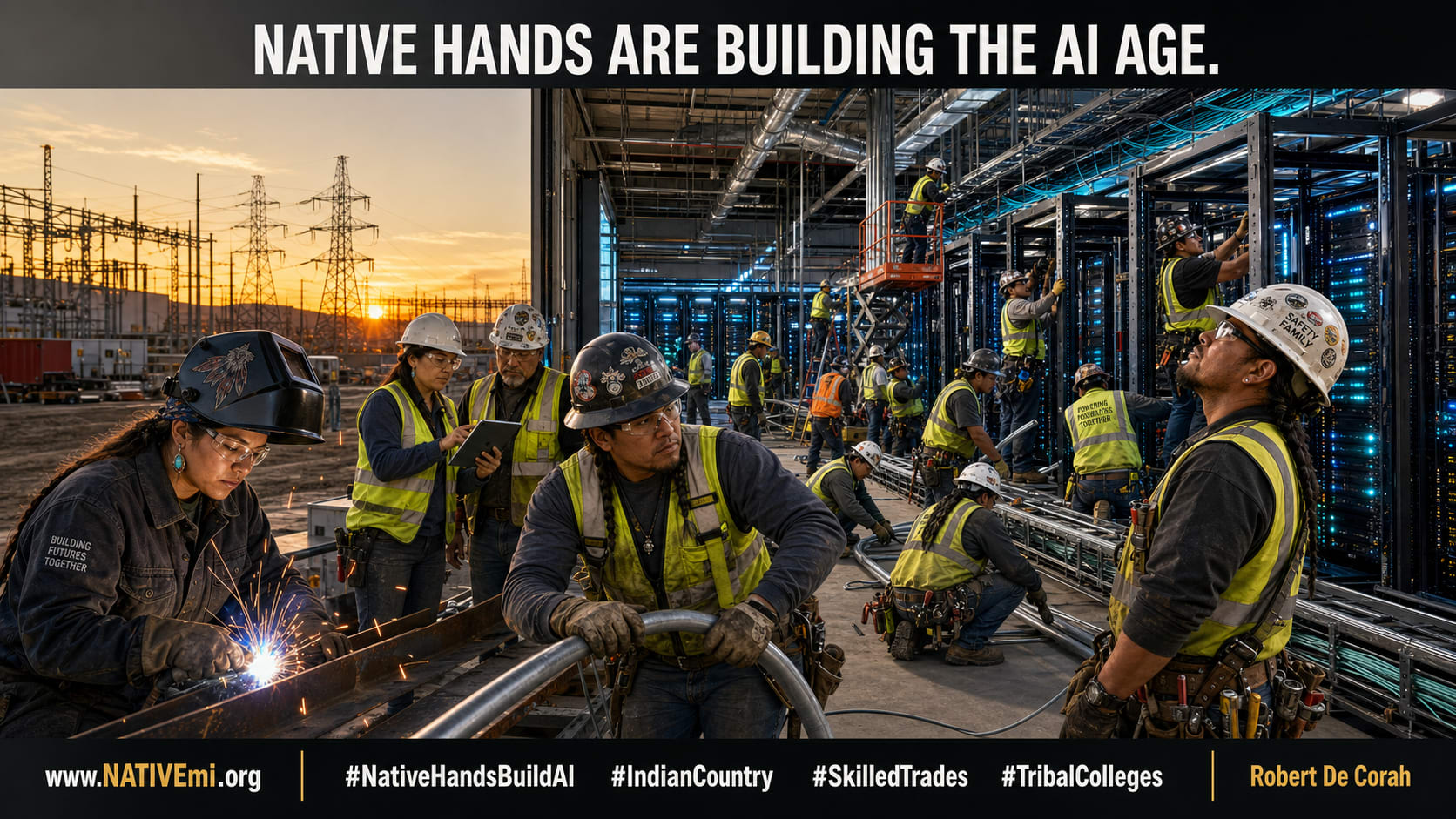
Will Native American Take the Challenge to Provide 2 Million Jobs Paying 100K
Every Reservation
Every State
I have visited 57 Reservations
But NOW IS THE TIME
TO ADD 2 MILLION JOBS
PAYING BETWEEN
$100,OOO TO $175,000
These jobs are what native Americans excel at.
# Native Hands Can Build the AI Age ## Why Indian Country belongs at the front of America's skilled-trades comeback My uncle Donnie Cornelius, Oneida Nation, learned to weld and wire at Haskell Indian Nations University. He built a life from those skills. That story should not be a memory. In 2026, it should be the model.
Note: - **BIA IGNITE Pilot** — the Bureau of Indian Affairs' new **Indigenous Growth in New & Innovative Trade Employment** program is offering **$100,000–$300,000 awards** (roughly 18–22 awards, up to $6.6M in the first cohort) flowing directly to Tribes and Tribal organizations through **638 contracts** for construction, ironworkers, utilities, energy, AI, drones, digital fabrication and advanced manufacturing training. Application deadline: **September 18, 2026** Many more resources detailed within this article.
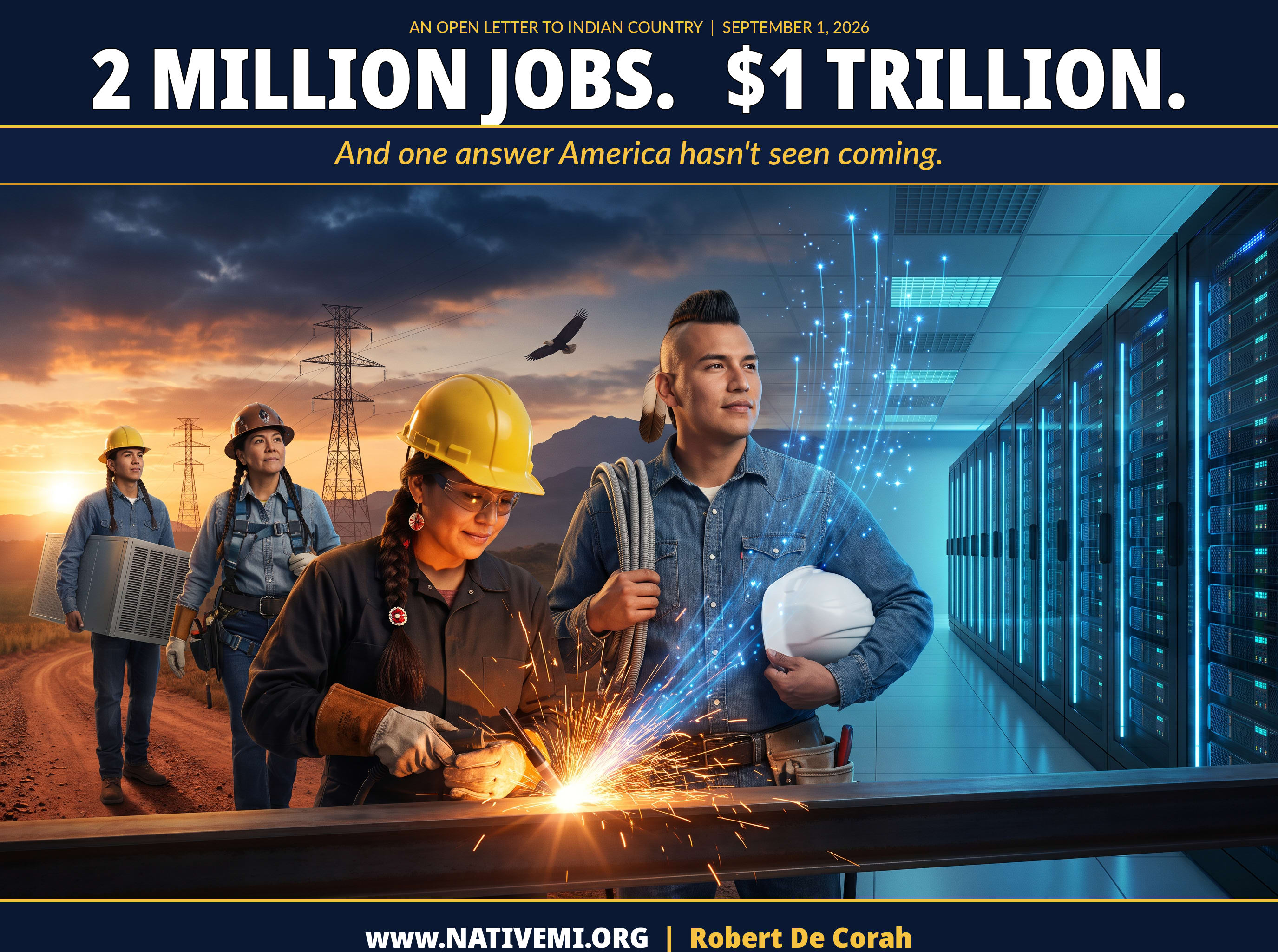
-- On September 1, Lowe's announced the largest cross-sector skilled-trades coalition in U.S. history: the **Building Futures Skilled Trades Coalition** — Lowe's Foundation with Nvidia, General Motors, AT&T, Bank of America, Duke Energy, Carrier, DEWALT and 75+ partners. The goal: train and certify **1 million skilled tradespeople by 2035** ([Fox Business](https://www.foxbusiness.com/economy/lowes-launches-major-effort-help-close-americas-skilled-trades-gap)). The reason is blunt. Janice Dupré, EVP of Human Resources at Lowe's and chair of the Lowe's Foundation, says the U.S. is short **2 million skilled-trades workers** — a gap costing the economy roughly **$1 trillion a year** ([Fox Business]
(https://www.foxbusiness.com/economy/lowes-launches-major-effort-help-close-americas-skilled-trades-gap)). The Department of Education projects up to **2.1 million skilled-trades jobs could go unfilled by 2030** ([Charlotte Observer]
And here is Dupré's most sobering line: **for every 5 people retiring from the trades, only 2 are entering** *Native Americans should not be at the back of this line. We should be at the front.** --- ## The AI boom is a blue-collar boom Nvidia's Jensen Huang calls the AI buildout "the largest infrastructure. The numbers back him up: - **439,000** construction workers short right now, mostly electricians, pipe layers and HVAC techs ([ITIF](https://itif.org/publications/2026/01/12/construction-industry-facing-worker-shortage-driven-by-growth-of-data-centers/)) - **500,000 electricians, 300,000 welders, 550,000 plumbers** short if every announced AI project is built on schedule - **300,000 new electricians** needed this decade, plus **200,000 to replace retirees**
Data-center construction jobs pay up to **30% more** than typical construction work — and most require **no four-year degree** Marvin Ellison, Lowe's CEO, said it best: "The next industrial revolution won't be built by algorithms alone. It will be built by the millions of skilled trade professionals who power, connect and move this country forward" ([Charlotte Observer]
-- ## Indian Country already trains these workers We don't need to invent this. The infrastructure is here: **Tribal colleges with trades programs:** -
**Haskell Indian Nations University** (Lawrence, KS) — the historic training ground for Native welders, electricians, carpenters and mechanics (
- **United Tribes Technical College** (Bismarck, ND) — Welding Technology, electrician certificates, GIS, energy auditing; -
*Turtle Mountain Community College** (ND) — HVAC, residential electrical, welding (including pipe welding), plumbing, process plant technology
*Aaniiih Nakoda College** (Fort Belknap, MT) —
AAS in Industrial Trades: carpentry, welding, HVAC, CNC, machining - **
Salish Kootenai College** (MT) — 8-week intensive welding program with daily stipend ([SKC] -
**Navajo Technical University** (NM) — new Construction Trades microcredentials; plumbing, heavy equipment and welding coming (
**Leech Lake Tribal College** (MN) — Electrical Technician, Carpentry, Welding -
**Cankdeska Cikana** (Spirit Lake, ND) — new HVAC AAS - *
*Fort Peck Community College, (MT)** — welding, electrical line workers, building trades, CDL, heavy equipment
**North Dakota Tribal College System** — $12M Hess "earn-and-learn" apprenticeship across all 5 ND tribal colleges **Tribal workforce & apprenticeship programs:** -
**Meskwaki Nation Apprenticeship Program** (IA) — DOL-recognized, NCCER-accredited in carpentry, plumbing, HVAC, electrical - *
*Choctaw C-TEC and Workforce Training Center** (MS) — NCCER credentialing in HVAC, electrical, industrial controls -
*Tulalip Tribes Vocational Training Center** (WA) — free 14-week hands-on construction training with direct-entry apprenticeship via TERO
**Dakota Prairie Apprenticeship Readiness Program** (NHSC) — the first tribal-college / building-trades-council partnership in North America -
**California Indian Manpower Consortium – Pathway to High Road Jobs** — 130 Native apprentices into construction and utilities -
**BIA IGNITE grant pilot** and **DOL Indian & Native American Programs (DINAP)**
*********************************************************************************************************
FOR COMPLETE ARTICLE WITH LINKS TO ACCESS INFORMATION ON MAKING YOUR DECISIONS ALL OF THE LINKS ARE AT https://www.dropbox.com/scl/fi/9bx34iqb6y56iroshrzc3/Native-Hands-Can-Build-the-AI-Age.docx?rlkey=232nqu8ycz7m4lr0b13zcgtz1&st=jq936jor&dl=0
**********************************************************************************************************
— federal funding pipelines for tribal workforce training in construction, infrastructure, AI, drones and advanced manufacturing **Scholarships that pay for trade school:
** Cobell Vocational & Trade Scholarship,
Tulsa Welding School Native American scholarships,
Refrigeration School tribal-funding partnerships Indian Country doesn't have a training capacity problem. It has a **scale, coordination and demand-direction problem** — one this coalition can solve.
## Why Native workers are positioned to lead
**1. The infrastructure is already built.** Tribal colleges teach exactly the trades in shortage. The Dakota Prairie and NDTCS/Hess models prove tribal colleges can plug directly into apprenticeship pipelines.
**2. Time-to-earning is short. Debt is low. Wages are high.** Dupré: certifications can take 90 days to 6 months at very low cost, leading to six-figure careers
**3. The AI buildout is landing on our map.** Nearly **3,000 data-center projects** are underway or planned nationwide, each needing 1,500–3,000 workers at peak — roughly **4.7 million temporary construction jobs** Land, power, water, transmission corridors — that map overlaps Indian Country.
**4. TERO gives Native workers built-in preference.** Tribal Employment Rights Ordinances provide Indian Preference in employment on or near tribal lands, plus direct-entry apprenticeship in many states *
*5. Native workers can be the teachers, not just the trained.** Every "Uncle Donnie" story in Indian Country is a master tradesperson in the making — instructors, mentors and program leads for the next decade of apprentices. --- ##
The current administration can transform Indian Country with jobs — by putting trade schools on the reservations *A note to the federal workforce reading this — BIA, DOI, DOL, Education, Commerce, White House policy staff, congressional staff and tribal liaisons: every federal lever needed to fund reservation-based trade schools and expand trades programs at tribal colleges is already active in 2026. This is not a request for new legislation. It is a request to point existing authorities and appropriations at Indian Country.*
### Active federal levers (FY 2025–2026) - **Executive Order 14278 — "Preparing Americans for High-Paying Skilled Trade Jobs of the Future"** directs the Departments of Labor, Education and Commerce to submit a plan to reach and surpass **1 million new active Registered Apprenticeships** and to strengthen ties between the education system and apprenticeship through the Perkins V Career and Technical Education Act ( - **America's Talent Strategy** codifies the 1-million-apprentice goal as national policy
([DOL – America's Talent Strategy - **$162 million** already awarded by DOL through five cooperative agreements to expand Registered Apprenticeship in construction, manufacturing, maritime and nuclear - *
*$145 million** Pay-for-Performance Apprenticeship Incentive program ( - **$85 million** State Apprenticeship Expansion Formula grants — states can direct these to tribal college partnerships - **$86 million** Industry-Driven Skills Training Fund, including welding, marine electrical and manufacturing - **BIA IGNITE Pilot** — the Bureau of Indian Affairs' new **Indigenous Growth in New & Innovative Trade Employment** program is offering **$100,000–$300,000 awards** (roughly 18–22 awards, up to $6.6M in the first cohort) flowing directly to Tribes and Tribal organizations through **638 contracts** for construction, ironworkers, utilities, energy, AI, drones, digital fabrication and advanced manufacturing training. Application deadline: **September 18, 2026** -
**DOL WIOA Indian and Native American Programs (DINAP / Section 166)** — the standing federal channel for tribal workforce training, education support and services, now on a four-year award cycle for Program Year 2026 - **BIA Vocational Training authority (Snyder Act, 25 U.S.C. § 309)** — the long-standing statutory basis for federally funded vocational training for American Indians and Alaska Natives, run through the BIA Division of Workforce Development ### What the administration can do without new legislation
These five actions are all executable under current authorities and appropriations:
1. **Prioritizing tribal colleges and reservation-based training centers as target recipients** for the $162M Registered Apprenticeship expansion, $145M Pay-for-Performance, $85M state formula and $86M Industry-Driven Skills Training pools — the same pools already flowing under EO 14278
2. **Scaling BIA IGNITE from a pilot into a permanent, multi-year program** so every federally recognized tribe can stand up an implementation-ready trade school pathway — welding, electrical, HVAC, plumbing, ironwork, line work, heavy equipment, fiber-optic install, data-center technician — funded through 638 self-determination contracts
3. **Directing Perkins V CTE funding** — which EO 14278 explicitly names — into tribal high schools, BIE schools and tribal colleges so students can move from high school shop class straight into Registered Apprenticeship on their own reservation
4. **Coupling AI-infrastructure permits with tribal-workforce commitments.** When the federal government approves data centers, transmission lines, fiber trunks and grid upgrades on or near tribal land, condition support on TERO-aligned hiring and apprenticeship placements through tribal colleges.
. **Using the BIA Trust responsibility as the framework.** The federal government's trust obligation to tribes is the same legal foundation that already funds BIA vocational training under 25 U.S.C. § 309 — the administration can invoke that obligation to permanently anchor reservation-based trade schools inside the workforce build-out ### For federal staff wanting to move on this now - **Tribes and tribal organizations:** the **FY 2026 BIA IGNITE application deadline is September 18, 2026**
— submissions go to **JPTignite@bia.gov**, not Grants.gov. Program contact: **Rebekah HorseChief, BIA Division of Workforce Development, (505) 706-6536** ([BIA IGNITE](https://www.bia.gov/bia/ois/dwd/pjt/IGNITE)). - **State workforce agencies:** SAEF formula grants (round 4, $85M) can be committed to tribal-college / building-trades-council partnerships modeled on the Dakota Prairie program ([DOL SAEF](https://www.dol.gov/newsroom/releases/eta/eta20260413)). -
**BIE and tribal high schools:** Perkins V Reserve Funds are specifically named in EO 14278 as a channel to connect secondary CTE to Registered Apprenticeship ([EO 14278](https://www.whitehouse.gov/presidential-actions/2025/04/preparing-americans-for-high-paying-skilled-trade-jobs-of-the-future/)). - **DOL ETA / DINAP grantees:** PY 2026 WIOA Section 166 awards run on a four-year cycle — an opportunity to lock in tribal trade-school partnerships now ([DOL WIOA INA PY 2026](https://www.dol.gov/grants/program-year-2026-workforce-innovation-and-opportunity-act-wioa-indian-and-native-american)). -
**Agency contracting officers:** federal permits and support for data centers, transmission and fiber projects on or near tribal land are a natural place to attach TERO-aligned hiring and apprenticeship commitments through tribal colleges. --- A reservation with its own trade school is a reservation with its own economy. Every welder, electrician, HVAC tech, lineman and pipe fitter trained on tribal land keeps wages, tax base and mentorship inside Indian Country — and puts Native hands directly on the AI-era infrastructure being built next door.
This administration has already declared skilled trades a national priority. Extending that priority onto reservations is the fastest, most concrete way it can transform Indian Country in this decade. ---
## A five-step call to action
1. **Route Gable Grants and coalition-partner funding directly to tribal colleges** teaching welding, electrical, HVAC, plumbing, line work and heavy equipment ([Lowe's Foundation](https://www.lowesfoundation.org/gable-grants)).
2. **Scale the Dakota Prairie model** — tribal college + state building-trades council — into every state with a tribal college.
3. **Wire Nvidia, GM, AT&T, Duke Energy, Carrier and Bank of America project pipelines into TERO offices** so AI-era infrastructure near tribal lands hires Native tradespeople first.
4. **Use BIA IGNITE and DOL DINAP funding to add AI-adjacent certifications** — data-center technician, fiber-optic installer, high-voltage electrician, industrial HVAC — on tribal campuses.
5. ** Tell the story.** Elevate Native master tradespeople as visible instructors and role models, so Native youth grow up seeingwelder, electrician, lineman and HVAC crew chief as respected Native careers. ---
The country is short 2 million hands and losing $1 trillion a year for the lack of them. The AI economy will not run on algorithms alone. It will run on the people who pour the pads, pull the conduit, weld the racks, install the switchgear, plumb the cooling loops, string the fiber, and keep the HVAC alive.
Native Americans belong at the front of that workforce. The schools are here. The programs are here. The funding channels are here. The projects are landing on our doorsteps.
All that's missing is the decision to put Indian Country at the center of the plan. *What tribal college, apprenticeship program or Native tradesperson should be part of this conversation?
Tag them below.* **#SkilledTrades #NativeAmerican
#TribalColleges #Workforce #AI #DataCenters #RegisteredApprenticeship #IndianCountry #BIA
#DOL #FederalWorkforce #TribalSovereignty #WorkforceDevelopment #PublicPolicy #EO14278
#Haskell** **Reframed the administration section for policy readers:** - Opens with a direct address to BIA, DOI, DOL, Education, Commerce, White House policy staff, congressional staff and tribal
liaisons - Frames the ask as "point existing authorities and appropriations at Indian Country" — not new legislation - Organized into three government-friendly subsections: **Active federal levers**,
**What the administration can do without new legislation**, **For federal staff wanting to move on this now** **Added an action block for federal staff** — specific, dated, contact-level detail: - BIA
IGNITE deadline (September 18, 2026), submission email, program officer name and phone - SAEF round 4 formula grants for state workforce agencies - Perkins V pathway for BIE and tribal high
schools - WIOA Section 166 four-year cycle for DINAP grantees - TERO-aligned hiring hook for agency contracting officers **Updated hashtags for government reach:** Added
`#RegisteredApprenticeship #BIA #DOL #FederalWorkforce #TribalSovereignty #WorkforceDevelopment #PublicPolicy #EO14278` so it surfaces in federal-workforce and policy feeds.
Gallery
Will You Train Your Tribe for $100,000 jobs?